 |
|
THE WORLD COMES TO MY VILLAGE |
|||
Story by Vicki Hoefling Andersen, photos as attributed |
|||
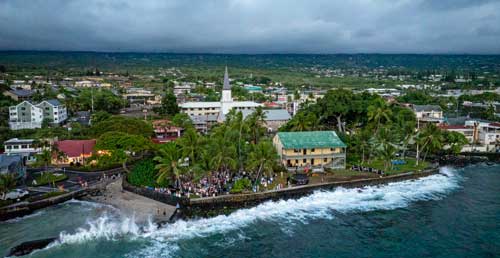
Every October the world descends upon my village for two semi-chaotic weeks. It’s the IRONMAN World Championships and this year we hosted nearly 2,600 competitors plus their entourage of coaches, family and friends, representing 85 different countries.
Some locals skip town but many of us (nearly 5,000 again this year) volunteer to help. It’s a big impact on a community of just over 24,000. Our handful of roads are congested with the influx of visitors plus a large segment of one of our island’s two actual “highways” is being shared with bicyclists and runners training for the big day. (Yes, they do close the highway on race day.) While most people have heard of the IRONMAN, few outside the triathlete world know of its transition from humble beginnings into the birth of a global sport. In 1977 an argument began about which is the toughest endurance athlete: swimmer, cyclist or runner. Rumored that beer was involved, the swimmers started ribbing the runners. U.S. Navy Commander John Collins and wife Judy, having helped organize a run-swim competition, decided an “Around the Island Triathlon” the following year might settle the dispute. They linked the Waikiki Roughwater Swim, the Honolulu Marathon, and a route from the Around-Oahu Bike Race. Hoping this 140.6 mile competition would become an annual event, Judy and John challenged each other, "If you do it, I'll do it," adding, "...whoever finishes we'll call the Iron Man." Thus in 1978, the first-ever Hawaiian Iron Man challenge was held on Oahu, where the entrants were told, “Swim 2.4 miles! Bike 112 miles! Run 26.2 miles! Brag for the rest of your life!” Although many of them were military men, including a Navy Seal, only 12 made it to the finish line. Word got out and in 1979 there were 50 entries. The event was covered by Sports Illustrated which generated letters from people around the world who wanted to enter. Catching the eye of major media outlets, in 1980 ABC's Wide World of Sports filmed the more than 100 athletes who showed up. The growth and logistical challenges prompted the decision to move the race to Kona on Hawaii Island (aka the Big Island) in 1981, and 326 folks signed up. What Kona now dishes up is what many consider the world’s toughest one-day sporting experience. Leading up to race day, events are planned in which everyone can participate. Competitors, their friends and family, locals and visitors to Hawaii mingle, chill for a while, celebrate the World Championships, and speculate about the outcomes. Prior to Saturday’s Big Day, I helped “marshal” the Parade of Nations on Tuesday afternoon when athletes from around the world came together to walk down Ali'i Drive, proudly flying their country’s flag, while at various places along the route performers provided Polynesian and Asian music to liven the scene.
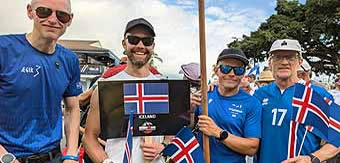
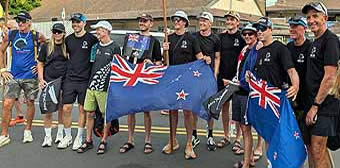
I hooked up with four triathletes from Iceland (above left) who were surprised to find someone in Hawaii who has visited their homeland. We talked story, as Hawaiians refer to shooting the breeze, about volcanoes, glaciers, and elves. The team consisted of (pictured left to right) Einar Sigurjonsson, Trausti Gunnarsson, Geir Omarsson and Stefan Karl Saevarsson. Photo on the right is New Zealand’s team, one of four countries into which IRONMAN expanded their global reach in 1985. Ten of New Zealand’s team finished the race including a man (Jack Moody, fifth from the right) and a woman in the Pro category.
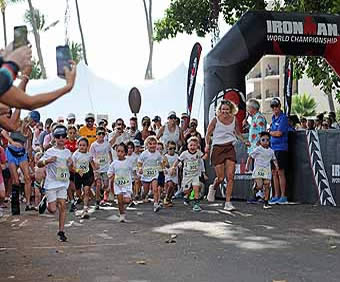
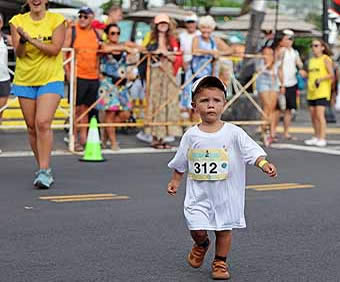
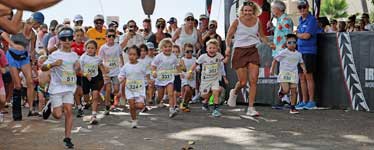
The Keiki Dip-n-Dash is a favorite of the kids (“keiki” is Hawaiian for children). An approximate 150-yard “dip” is followed by either a .25 mile (2-4 year olds) or .7 mile (5-15 year olds) “dash” down Ali’i Drive.
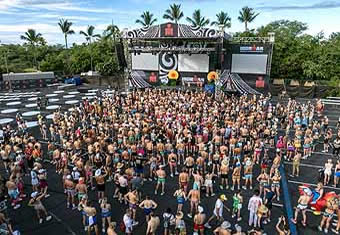
Thursday morning before race day finds hundreds of people “dressed” for the Underpants Run along Ali’i Drive. Started in 1998 as a good-natured protest against athletes wearing Speedos and skin-tight swimwear all over town, it has become a beloved tradition where hundreds of folks, with kids in strollers and pets in tow, jog or walk the nearly 2-mile fun run and charity fundraiser. Some are decked out in costumes or themed outfits, otherwise the only requirement is you must at least wear... Under Pants!
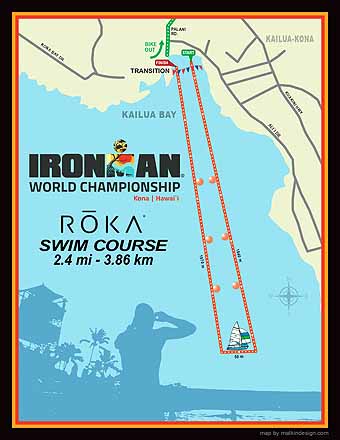
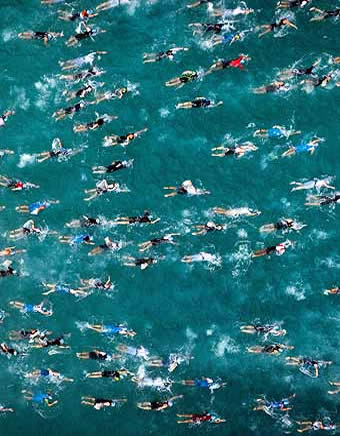
Race day starts as the sun is just peeking the over the top of Hualalai, the dormant volcano at whose feet Kona is situated, with a 2.4-mile (3.8 km) swim in the waters of Kailua Bay. Hopefully in future, it isn’t too choppy like it was this year, or threatened with a box jellyfish bloom which often occurs a week or so after a full moon, also feared this time.
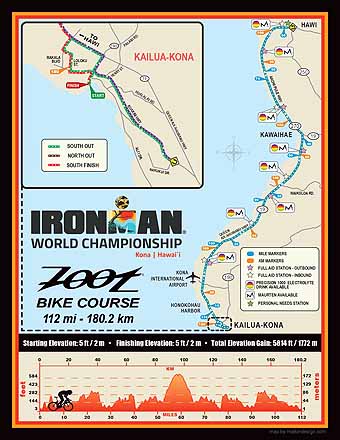
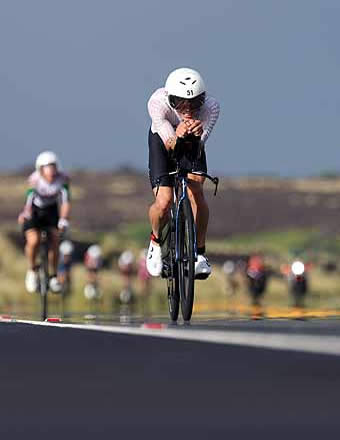
After exiting the water, swimmers duck into a changing tent on the pier, mount their land steed, and head for a 112-mile (180 km) bike ride up the Queen Ka‘ahumanu Highway, locally and more easily referred to as “the Queen K.” The trip to Hawi at the north tip of the island includes a 5,814-foot elevation gain, and unpredictable crosswinds called the ”ho’omumuku” which can gust over 30 mph. By now the sun is blaring off the lava fields over which the highway is built, and dramatic ocean views are a tempting distraction for the riders.
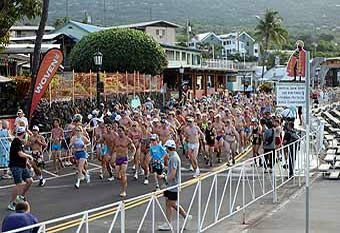
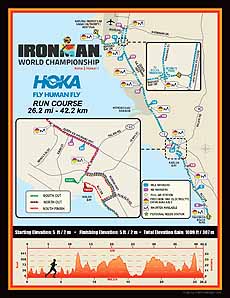
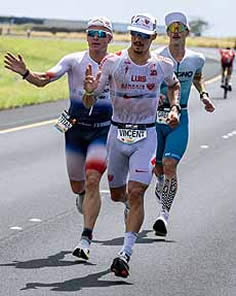
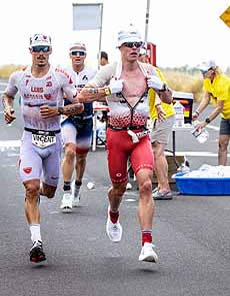
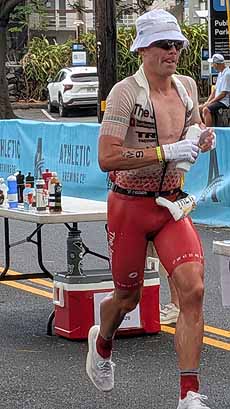
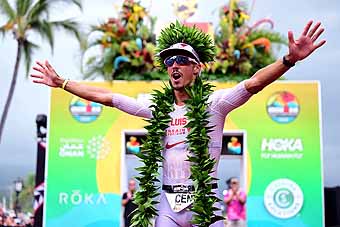
Back in Kona the athletes ditch their bikes and head back up the Queen K for a 1,009-foot climb to the Energy Lab at the Ocean Science and Technology Park near the airport. Considered the most grueling part of the run, the E-Lab has become known as The Wall. Athletes are starting to get really exhausted, there are no cheering spectators to spur them on, and the brutal heat and humidity are taking their toll. Re: center picture above: Leading the charge, Vincent Luis/France took first place on his Kona debut which was also to be the final race of his career. Kristian Blummenfelt/Norway tries to overtake him but will finish in eighth place after taking third last year. In third place at this point, Gregory Barnaby/Italy eventually finished fourth. On the right, Matthew Marquardt/USA moves into the lead but finished in third place, having to sit out a 3-minute penalty. The final leg of this 26.2-mile (42.2 km) run heads back into Kona, makes a loop along the legendary and historical Ali‘i Drive, and finally back to the finish line near the pier.
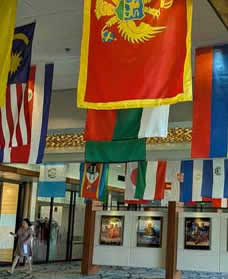
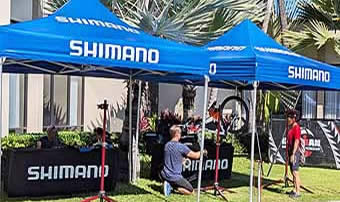
IRONMAN is headquartered at the King Kamehameha Kona Beach Resort, while the huge IRONMAN Expo took over a parking lot and open-air community building a bit further down Ali’i Drive. National flags draped the gallery hall and various vendors provided repairs and offered IRONMAN merchandise on the grounds of the King Kam. Volunteers were everywhere doing their best to take care of the athletes and support staffs. We greeted them at the airport and helped navigate luggage, gear and rental vehicles. Volunteers checked in attendees and answered questions (a LOT of questions).
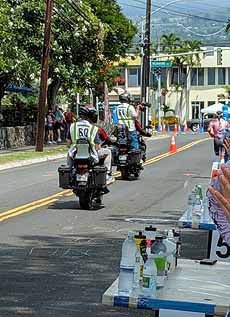
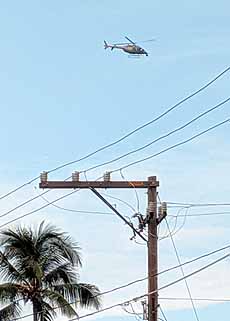
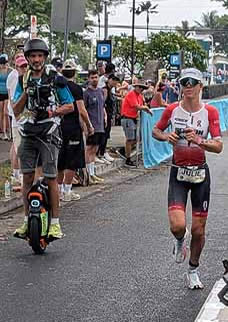
I volunteered again to staff the Media Room for a day, greeting and helping journalists from all over the world who were covering the event. Boy, are they tough on credentialing – it takes a pretty significant outlet to get access. They record from helicopters and with drones, from the backs of motorcycles and atop electric unicycles. Above left, during the 2025 Championship, a duo of motorcycle-mounted videographers follow the 2024 winner, Laura Phillip/Germany. Above right, a photographer on electric unicycle captures Julie Derron/Switzerland on her way to third place. Volunteers assisted the swim-to-bike transition stage and operated nutrition and first aid stations. We helped with crowd control as the spectators, more numerous than the field of athletes, lined much of the route and could get overly enthusiastic when their family member/friend/favorite athlete came into view. (This year I watched a woman who – when her favorite contender came into view – ran into the street waving a sizable version of her country’s flag so her friends could get their Instagram shots...EXCEPT she jumped right into the path of another Pro category runner!) We helped organize IRONMAN and locally-related events such as the Parade of Nations, the Keiki Dip-n-Dash, and the Underpants Run.
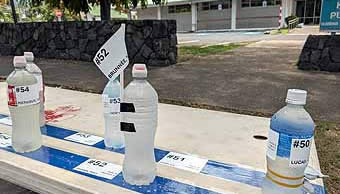
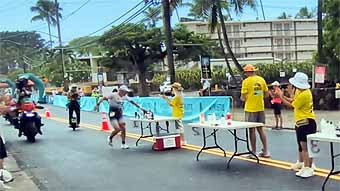
The last two years I’ve volunteered at a Pro Fluids Aid Station. While numerous “aid stations” are located along the bike and run routes for all competitors, the Pro Fluids Aid Stations contain each Pro field competitor’s personally prepared combination of hydration fluids and electrolytes, labeled with their name and bib number and set out in numerical sequence (above left). Above right, one of the sport’s consistently top finishers, Kristian Blummenfelt/Norway, slows down just barely enough to grab his bottle. Early on, IRONMAN set a new standard for equal distances, rules, and prize money for both men and women. IRONMAN triathlons are held all over the world with approximately 150-170 qualifying events a year. Races span the globe: Algeria, Argentina, Australia, Austria, Brazil, Canada, Chile, Denmark, Estonia, France, Germany, India, Ireland, Italy, Kazakhstan, Malaysia, Mexico, New Zealand, Norway, Philippines, Poland, South Africa, South Korea, Spain, Sweden, Switzerland, Taiwan, United Kingdom, United States of America, Vietnam, Wales and more. The “Top Guns” of the sport, the Pro Series itself ran over 16 races in 2026. But the pros are just a small portion of the people who take on the IRONMAN World Championships in Kona.
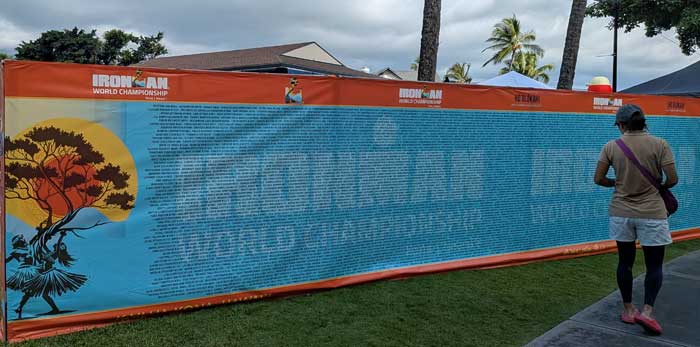
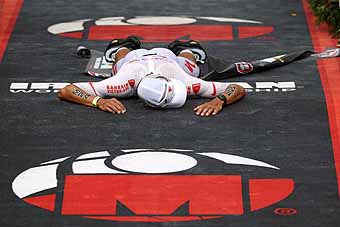
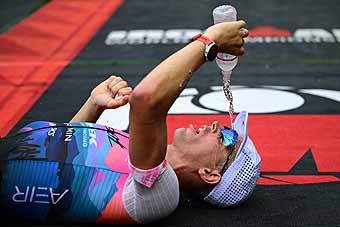
A very long banner outside the King Kam Hotel listed all of this year’s competitors. The Pro field comprised 110 (54 female, 56 male) of the 2,548 registered participants, Age-group athletes ranged from 18 to 83 years with an average age of 46, and included 11 age-group world champions from last year. Biggest group for men was 55-59 (269 of them), and a women’s tie between age groups 30-34 and 45-49 (85 each). Women comprised 28% of this year’s total field. IRONMAN is also proud to be inclusive with PC/ID (Physically Challenged/Intellectual Disability) and Handcycle divisions, with six PD/ID and three Handcycle competitors this year. Winning times: 7:47:27 for the Men and 8:36:29 for the Women. There is a 17-hour cutoff, but at 12:35am Sunday, I could still hear the announcers welcoming folks across the finish line. Just how grueling is it? Over one in five Pros did not make it, sidelined with injuries, migraines, flu or severe cramps - all bringing down even former world champions.
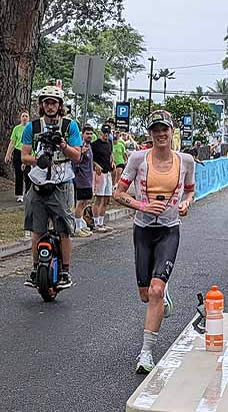
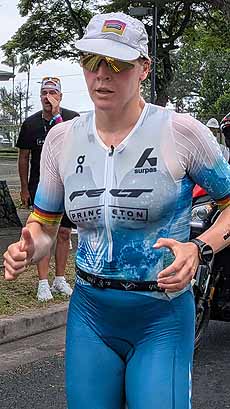
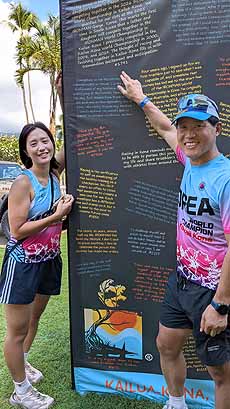
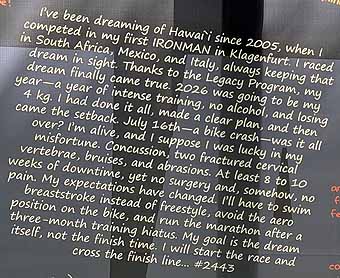
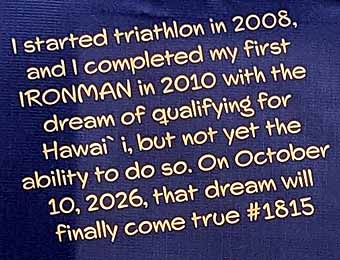
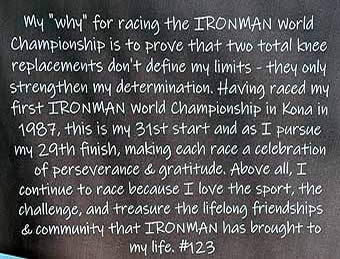
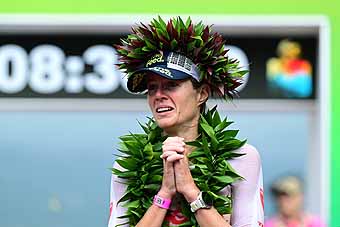
Taylor Knibb/USA (above left) smiles on her way to the women’s pro win, claiming the title that eluded her last year with one of the most exciting finishes in the history of the women’s race. Outfitted in blue, last year’s winner Solveig Løvseth/Norway appeared headed for a victory, but collapsed in the final mile and dropped to eighth. Matthew Marquardt/USA (above right) did a quick bottle-grab as he prepared to pound a few more miles of pavement. Qualifying for the world championships has changed over the years, evolving into mostly a points-based system for an athlete’s placement in other IRONMAN series races, but some alternative options include winning a charity bid and the Legacy Program. Established in 2012, the IRONMAN Kona Legacy Program rewards folks who have been competing in IRONMAN-branded events for at least 12 years, never qualified for or participated in the Kona World Championship and, with a few other requirements, may earn a special slot in the race. The IRONMAN World Championships ran uninterrupted until COVID-19 shut down the world in 2020, resulting in a 3-year hiatus. When it relaunched in 2023, the decision was made to split up the men and women, alternating between Kona and Nice, France. But it wasn’t a popular decision. That’s one thing that made this year’s event so special: men and women racing on the same day in the same location again. Everyone welcomed the decision (except perhaps some Kona residents who miss their laid-back village for two weeks in October). Athletes from the same country could support one another. Couples who both compete could race together. The organizers and media didn’t have to chase a world championship back and forth across continents. The biggest names were back to sharing the stage. It is astonishing what these athletes put themselves through to qualify and train for this event. Watching their faces one sees the determination and spirit to keep going despite the pain and appearing ready to collapse. At the same time, it is inspiring and heartbreaking. Outside the King Kam Hotel was a huge 2-sided “wall” of quotes submitted by this year’s competitors. Called the “My Why,” they share their motivations and reasons for pushing themselves to such extremes, the battles they’ve overcome, and what making it to Kona means to them. Many quotes will bring tears to your eyes.
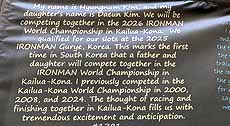
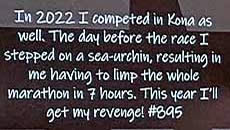
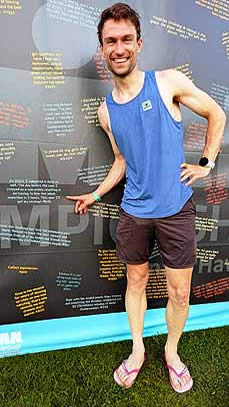
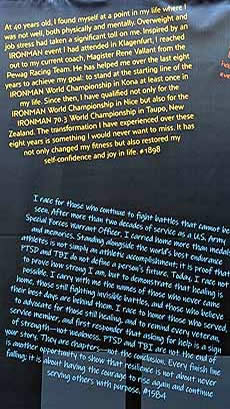
Daan van der Linden/Netherlands had just found his “Why” on the other side of the wall: revenge for last year’s sea-urchin misstep! Hyungnam Kim and his daughter Daeu Kim are South Korea’s first father-daughter team to compete in Kona, his fourth appearance and her first. Jurgen Seifried/Austria #1898 and Ariel Aponte/USA #1584 share what inspires them.
Over the years Kona has produced lot of heart-warming stories. In 1982, Julie Moss had been leading, but just 50 feet from the finish line she collapsed, struggled a few times to get up, then watched as Kathleen McCartney passed her by. But Moss was determined and the ABC cameraman caught her as she crawled on hands and knees until she could throw her arm across the finish line, a smile on her face that she had completed the race. Dick Hoyt was determined to help his son Rick, a victim of cerebral palsy, participate. They tried in 1988 but couldn’t complete the race. Returning the next year, Dick floated his son on a raft for the swim, rode him on the front of his bike (the two of them and their gear topping 350 pounds), and pushed him along the marathon route. When they crossed the finish line it showed the world what determination could do. Jon Franks became the first wheelchair competitor in 1994. Three years later John Maclean powered a handcycle and wheelchair across the World Championship finish line, and in 2008 Kyle Pease was the second quadriplegic to accomplish this feat. Competitors at the IRONMAN World Championships have also included Sister Madonna Buder, a nun from Spokane, Washington, nicknamed “The Flying Nun.” Inspired by a conversation with a priest, she began running when she was 48, attempted her first triathlon at age 52 and her first IRONMAN three years later. Born in 1930 and still with us, she has taken the win in twelve age-groups at the IRONMAN World Championship.
Every athlete has their own motivation, their own goal, their own vision of what is possible, and Kona has become the ultimate dream for many of them. This Ironman is infamous for the length and challenge of the courses, for capricious weather, and a race that is broadcast around the world. No matter how much training or preparation they have done, the hope of those athletes can be unraveled by little details that may or may not be within their control. But the dream lives on. Every year the world arrives on our doorstep, and every year we will welcome them with Aloha and do our best to make their journey worthwhile. We believe in IRONMAN’s mantra: Anything is Possible. ABOUT THE AUTHOR
|