 |
|
MALTA - A TINY COUNTRY WITH LOTS TO OFFER |
|||
Story and photographs by Brad Hathaway |
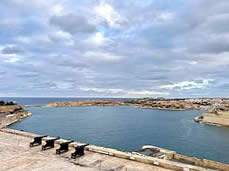
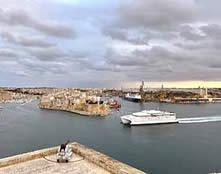
A two hour sail from the southernmost port of Sicily, our catamaran ferry entered the ancient harbor of Valletta, capital of the Republic of Malta — a modern nation of just over half a million people. It occupies an archipelago that has played important roles in European history over the reigns of the Phoenicians, Carthaginians, Greeks, Romans, Arabs, Normans, French, British and Axis powers in World War II. It is now a member of the European Union.
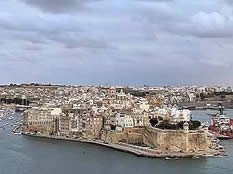
Valletta, a very compact city of just over a half square mile, with only a few thousand population, has a host of wonders along its narrow, hilly streets and harbor-facing city walls.
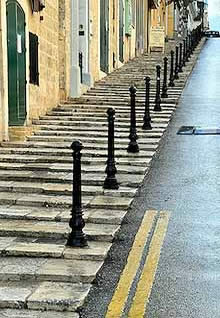
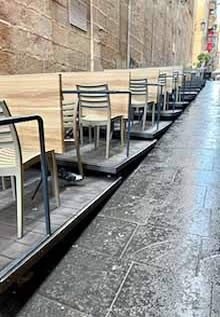
The streets are indeed hilly! Many have steps built into their sidewalks while restaurants have angled platforms for their tables for street-side dining.
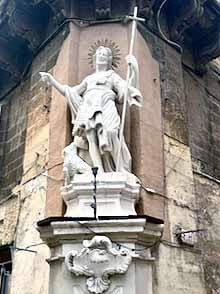
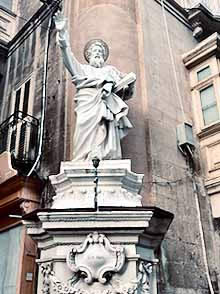
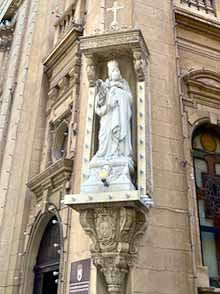
At the junction of many such streets you will find a “street shrine” of a sculpted saint in a niche indented at the corner of a building. Here are three such shrines. The one on the left is San Gwann or Saint John the Baptist with his sacrificial lamb. The one in the middle is San Pawl or the Apostle Paul. The shrine on the right marks the location of the Basilica of Our Lady of Mount Carmel.
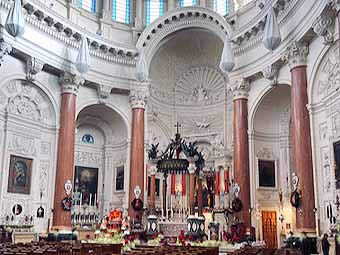
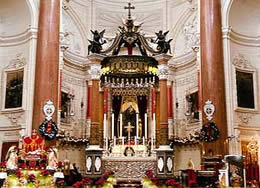
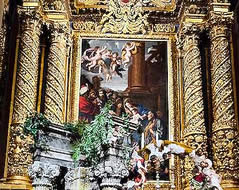
The Basilica of Our Lady of Mount Carmel was all but destroyed by the bombings of World War II. The statue, by Maltese sculptor Salvatore Dimech, dates to 1855 while the building itself is a recreation of the basilica completed in the 1980s. Its interior is simply spectacular. The alter sits before a painting of the Virgin Mary that may date as far back as the late 16th century, but she wears a crown that was added in 1881 by decree from the Vatican. Over it all hovers the underside of a nearly 140 foot high dome.
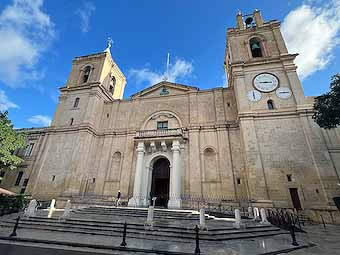
Most visitors head directly to the largest of the many churches, St. John’s Co-Cathedral. It is a co-cathedral because Malta has two. The other, St. Paul’s Cathedral, is in Mdina, some six miles to the west as the crow flies.
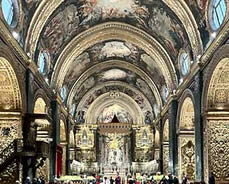
This church was built in the 1570s during a surge in power and pride on the part of the Knights of St. John after their victory over the Ottoman Turks. The interior, however, dates to a century later when the artist Mattia Preti devoted the last forty years of his life to creating a baroque masterpiece. When we arrived we were welcomed to their New Year’s Day mass.
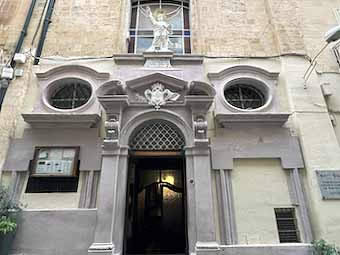
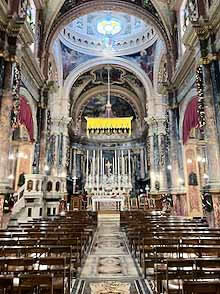
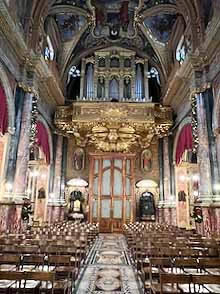
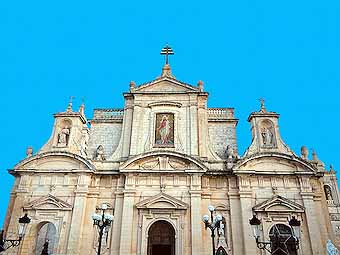
For us, however, the real find was a church called the Parish Church of St. Paul’s Shipwreck. It commemorates the event in 60 AD when the ship carrying St. Paul to Rome to appeal to Emperor Nero in his case of heresy and sedition ran aground in a storm off Malta. It has a relatively nondescript exterior.
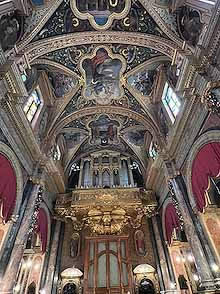
Despite that plain exterior, the interior is sumptuous.
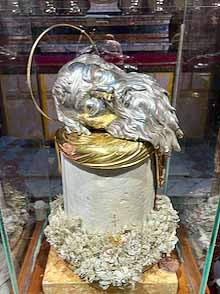
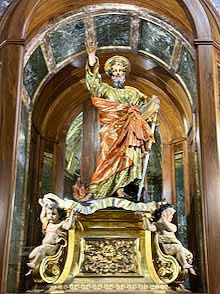
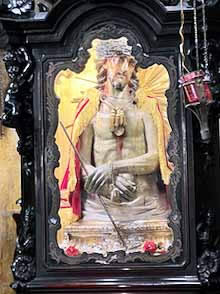
There are a number of interesting objects as well. For example, here you can find a silver sculpted bust of St. Peter’s head resting on a section of the column on which he was beheaded in Rome — he ultimately lost his appeal. The church is home to the impressive gilded statue of St. Paul carved in 1659 by sculptor/architect Melchiorre Gafá. It commands the space here except on Paul’s feast day when it is paraded through the city. And, there is a boxed image of Christ at the very moment Herod presented him to the crowd which is paraded through the streets of Valletta on Good Friday.
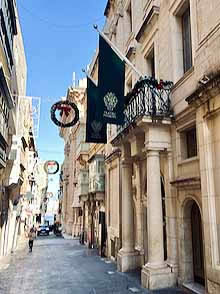
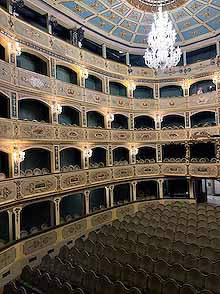
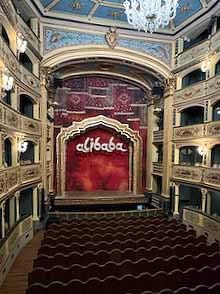
Not all the old buildings are churches. On Old Theater Street you will find, not surprisingly, a very old theater indeed. Teatru Manoel was named for the Grand Master of the Order of the Knights Hospitalier who had it built back in 1731 making it what some say is the third-oldest still-working theater in Europe. (I know — it doesn’t hold a candle to the Hvar Theater I told you about in Croatia, which dates to over a hundred years earlier.) The exterior of the Teatru Manoel may not seem too impressive, but step inside and you will find a sumptuous auditorium offering modern productions before an audience of around 600. We attended a classic British-style panto, the traditional holiday offering for family audiences involving over-the-top comedy, dancing, colorful costumes and the encouragement of audience participation (you are expected to yell “he’s behind you” to alert the hero to a threat from behind).
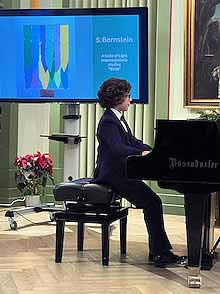
Adjacent to the old building, a more contemporary facility, the Sala Isouard, offers more intimate programming. When we visited they were offering a chamber music series of Christmas concerts. The one we attended featured a 9-year old pianist who has also played in Carnegie Hall in New York and Royal Albert Hall in London. For us he played well known music by Bach, Beethoven, Haydn, and less well known but very impressive works by Freidrich Kahlau and Seymour Bernstein — what a treat!
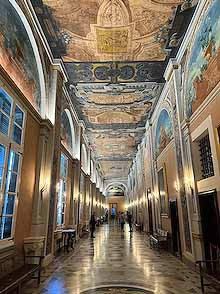
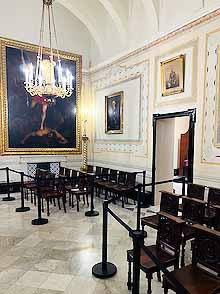
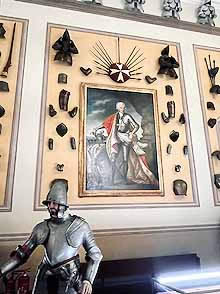
A few blocks away is the sixteenth-century Grand Master’s Palace — headquarters of the Order of the Knights Hospitalier of Saint John of Jerusalem, the Catholic military order that was so important during the crusades. During the British rule of Malta it was a Royal Residence for the representatives of the King or Queen of the United Kingdom. It also served as the seat of the Parliament of Malta from 1921 to 2015. You can tour and view the rooms of the Parliament as well as a huge collection of arms from the Palace Armory.
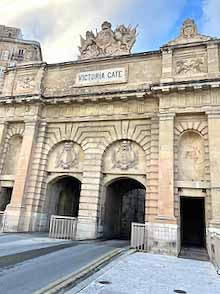
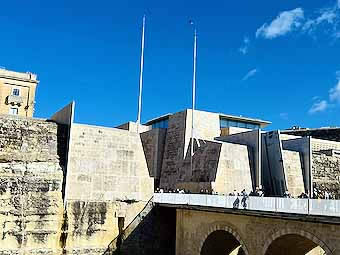
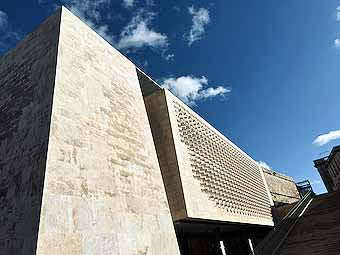
Today, the Parliament of Malta meets in a much larger and distinctly more modern facility. The new Parliament Building is part of the re-imagined entrance to the city designed in 2010 by noted Italian architect Renzo Piano. He replaced an earlier effort to re-design the city gate, returning the site to its original seventeenth-century dimensions but with a distinctly twenty-first century appearance.
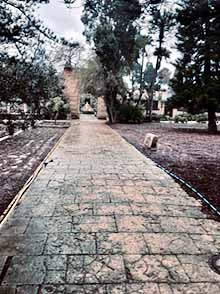
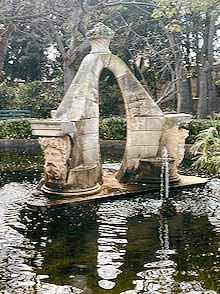
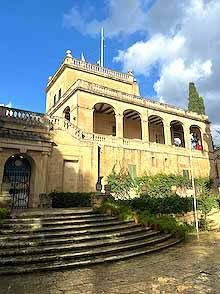
Leaving the city of Valletta behind, we ventured out into the interior of the island of Malta stopping first at the San Anton Garden which constitutes the grounds of the residence of the President of Malta. Originally a private park for the enjoyment of the Grand Master of the Maltese order, the park has been open to the public since 1882.
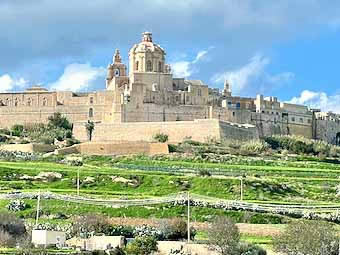
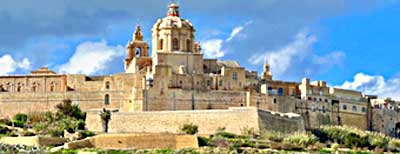
A short drive takes us up into hilly country where the ancient walled city of Mdina hovers above the more modern neighborhood of Rabat. Mdina was Malta’s first capital city, established by the Phoenicians in 870.
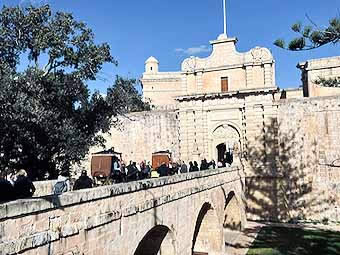
Mdina is approached over a bridge across a moat.
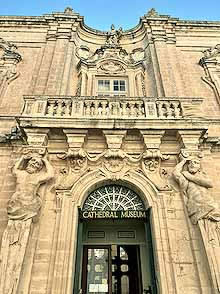
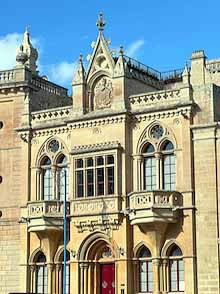
Inside the walled city, nearly every building is highly carved, including churches and palaces.
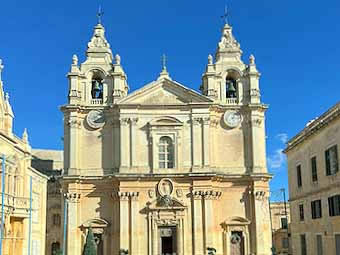
The most prominent of the buildings inside the walled city of Mdina has to be Malta’s other co-cathedral, St. Paul’s. A cathedral was built here in the 12th Century which was all but destroyed in 1693 when a huge earthquake wreaked damage across Sicily and Malta. Rather than re-construct it, plans drawn by architect Lorenzo Gafà were used to create what is considered a masterpiece of the Maltese Baroque style which was completed in 1705.
Grafá was the obvious choice to design the replacement cathedral because he had just completed the design and construction of the basilica which is dedicated to the same saint on the outside of the walled city above the Grotto of St. Paul. This location is reputed to be where Paul lived for the short time after being shipwrecked on Malta.
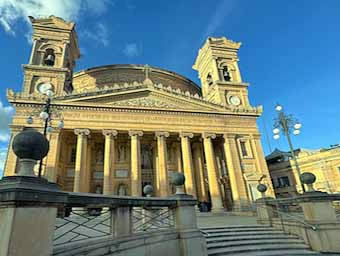
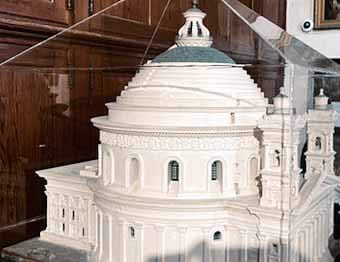
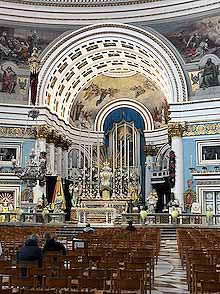
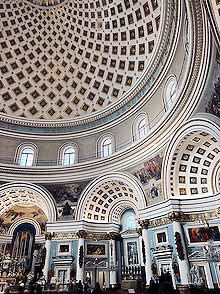
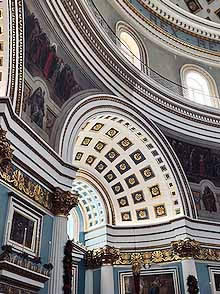
Not all the major churches, cathedrals and basilicas of Malta follow baroque or romanesque architectural rules. The Rotunda of Mosta (technically the Sanctuary Basilica of the Assumption of Our Lady) is a huge neoclassical structure referencing the Pantheon of Rome. Located in the center of this densely populated town (population just under 25,000), the Mosta Dome is visible long before the town as you drive up from Valletta or over from Mdina.
The circular interior of the Dome is huge. It measures 130 feet in diameter without a single pillar or obstruction. Its circumference is lavishly decorated with eight niches accommodating alters, sanctuaries, and open chapels giving the space an awesome ambiance. All of it sits under the world’s third largest unsupported dome.
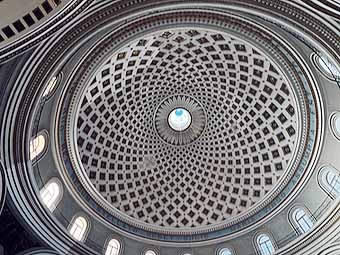
Look closely at the photo interior of the dome itself.
The white area where five dark squares are missing is the repair spot where, during World War II, a 500 kilogram high-explosive bomb dropped by a Nazi bomber pierced the dome while hundreds or even thousands of worshipers were attending evening mass. The bomb came through the dome, landed, then bounced around the center floor of the church, but hit none of the worshipers and failed to explode. This “Miracle of Mosta” is explained by some as divine intervention, by others as a failure of the fusing, and still others who suspect it was filled with sand instead of explosives by prisoners working in the bomb factory. After the war, a pilot reported that he had had to jettison some bombs over the city that evening after his plane was damaged before the bombs had been fused. I leave that for others to decide. ABOUT THE AUTHOR
|