 |
|
TALL TALES OF TALL TREES |
|||
Story and photos by Lee Juillerat |
Tall tales - and even taller trees.
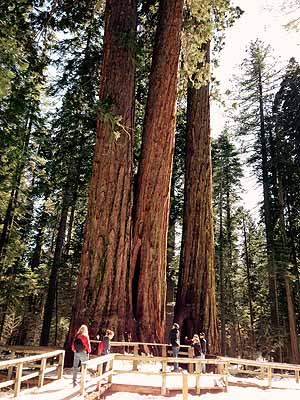
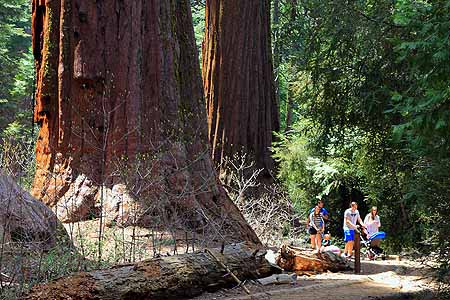
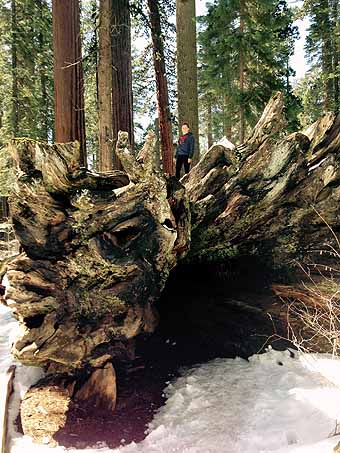
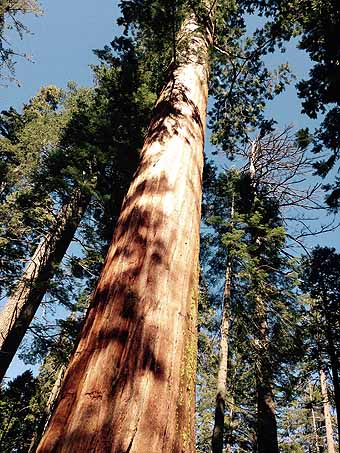
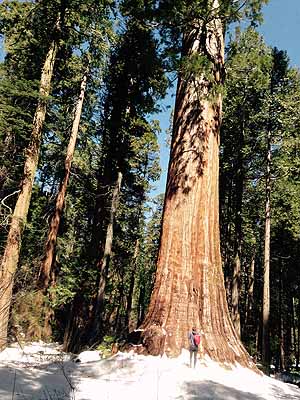
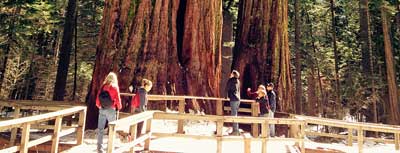
Even very tall people are dwarfed when standing by the Giant Sequoias at Calaveras Big Trees State Park in California's Sierra Nevada foothills. That's because many rise 250 to 300 feet above ground, with the tallest being more than 325 feet.
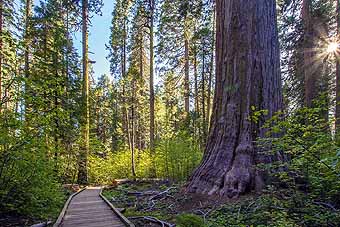
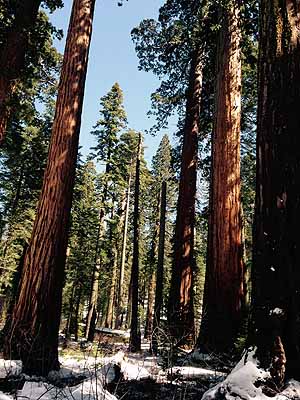
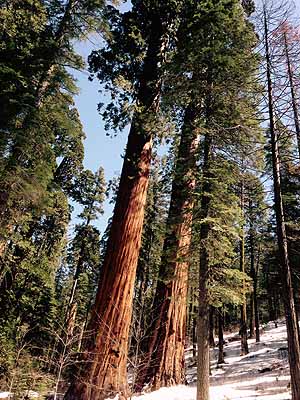
Giant Sequoias, known as Sierra redwoods or Sequoiadendron giganteum, are the focus of Big Trees State Park's 1.7-mile North Grove Trail. The loop route weaves its way through a grove of towering redwoods, which seem to have perpetual golden suntans. It's worth purchasing a trail guide that greatly expands information posted on trailside markers. Tall tales about the tall trees began in 1852 when people thought Augustus T. Dowd was telling tall tales about the sights he saw while chasing a wounded grizzly bear. As the trail guide notes, "Dowd was a colorful character and his story of the big tree was initially met with skepticism" until he convinced others to see for themselves.
Seeing is believing, and that's what people have been doing ever since.
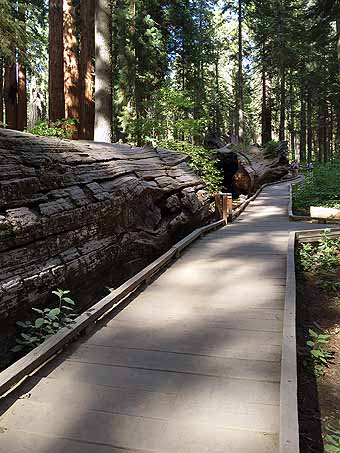
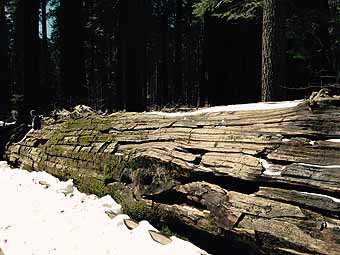
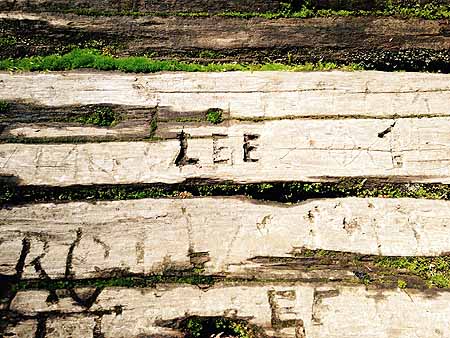
The tree that stumped Dowd in 1852, called the Discovery Tree, was short-lived after its discovery. Stripped of its bark and felled in 1853, the Big Stump is the first stop along the well-marked trail. Its history seems a tall tale: It took five men 22 days to drill holes in the monstrous tree - which was more than 25 feet in diameter at its base and more than 280 feet tall - but it was several days before it toppled over. Its bark was assembled into its original form for a traveling exhibit but was destroyed by fire a year later. Despite protests by Dowd and John Muir, the stump was planed smooth to serve as a dance floor while a two-lane bowling alley and bar were built on the fallen giant. The Big Stump is just the North Grove Trail's first discovery. The route passes by other giants, including the Empire State, so named because its base diameter is 30 feet. Others include the Granite State Tree, the Siamese Twins (two trees that seemingly merge into one about 50 feet off the ground), the Old Bachelor, the Mother and Son, the fallen Hercules and Father of the Forest trees, the Mother of the Forest, the Pioneer Cabin Tree, the Abraham Lincoln Tree, the Three Graces of Greek Mythology, and the Sacrificial Tree.
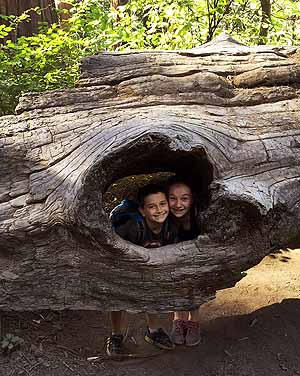
Most have their own tales. For example, because of its wide base and large fire scar, the Pioneer Cabin Tree's base was carved open wide and high enough for people and cars to pass through, making it a popular tourist destination. In January 2017, however, the weakened tree fell and shattered. The Mother of the Forest was alive when it was stripped of its bark in 1854. Speculators had its bark reassembled at exhibitions that lured thousands of gawkers in New York City and London. But its destruction sparked fury - and also an awareness that the Giant Sequoias needed protection. Among those condemning the tree's treatment was Muir, who wrote, "Skinning this tree alive is as sensible as skinning our great men would be to prove their greatness."
Early preservationists helped prevent the loss of other trees in the grove, which experienced several ownership changes until it was bought in 1900 by Robert P. Whiteside, a lumberman who made a "gentlemen's pledge" to not log the grove. Eventually, in 1931, public pressure led to including the grove under the protection of the California State Park System.
There's much to see and appreciate along the trail, including such other trees as sugar pines, white firs, incense cedars, ponderosa pines, and spring flowers like mountain dogwoods, red snow plants, and hazelnuts. The walk, which begins and ends near a visitor center/museum, can be continued on the Grove Overlook Trail. This trail rises partway up a ridge, parallels a portion of the North Grove Trail, and offers views from somewhat above the Giant Sequoias. From the same junction, the River Canyon Trail climbs 1,000 feet to an overlook, or - for people wanting a longer challenge - an eight mile out-and-back hike to and from the Stanislaus River.
However it's done, the North Grove Trail features the world's tallest trees and a history of tall tales.
Giant Sequoia factoids * From the end of the last Ice Age 12,000 to 5,000 years ago, Giant Sequoias were widespread over much of the Sierra Nevada mountains. The groves are a relatively recent phenomenon and only a few tree generations old. * Early records of California's Native Americans list only one name for Giant Sequoias in the Miwok language, "woh-who-nau," or "wowona," a word supposedly formed in imitation of the sound of an owl, the sequoias’ guardian. * One Giant Sequoia cone contains an average of 200 seeds. A mature tree can have 7,000 cones, which means each large Giant Sequoia can have up to 1.4 million seeds. * Giant Sequoias are very brittle and tend to shatter when felled. The amount of wasted wood from logging Giant Sequoias is estimated at up to 75 percent.
The North Grove Trail The North Grove Trail is located in Kings Canyon National Park in California, so there are standard U.S. National Park entrance fees for entry: $35 per vehicle, $20 per person, $80 for an annual pass which is valid for all National Parks. The fees apply whether you enter by car, motorcycle, or on foot/bike. If you are hiking the North Grove Trail on foot, you still need to pay the per‑person fee unless you have an annual pass or a multi‑day pass. The North Grove Trail starts from the General Grant Tree parking area in the Grant Grove area of Kings Canyon National Park. From there, you follow a dirt loop through a forest of giant sequoias. If you plan to hike multiple trails in the area, such as the Dead Giant Loop, combine them into one entry and pay the per‑person fee just once. About the Author:
|
||||||||||||||||||||||||||||||||||||||||||